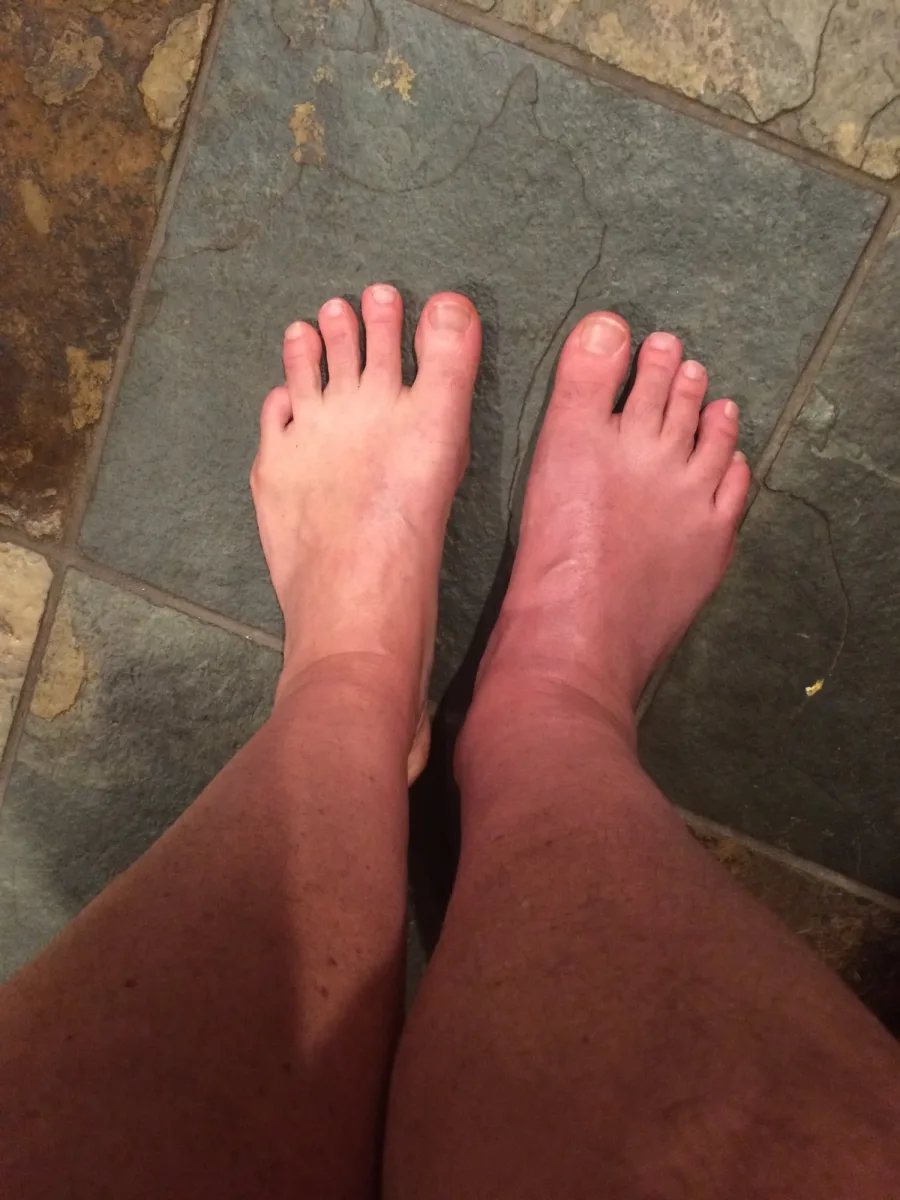
Maybe you've had pain that doesn't make sense. It doesn't match the injury, it won't quit, and doctors run out of things to say. If your skin has changed color, or you've noticed new hair growth, or touch itself has started to hurt, you're not imagining it. This has a name: Complex Regional Pain Syndrome, or CRPS.
I know it from the inside. Ten years ago I broke my leg and both ankles badly, one of the worst breaks the doctors said they had seen: three bones, twelve screws, a titanium plate. What came after the surgery was worse than the break, burning pain that didn't stop. I remember sitting in a tub of water, just trying to cool it down, and wishing I could disappear.
I did not recognize this pain. When I went looking for answers, I could only find two sentences about it in my old anatomy and physiology textbook, there was almost nothing else written about it at the time. CRPS is still considered rare and often missed. Research puts the incidence at roughly 5 to 26 new cases per 100,000 people each year, and it affects women three to four times more often than men.[7] Even that number may be too low. Researchers have pointed out that diagnostic criteria for CRPS have changed over time and that the condition is frequently missed or mistaken for something else, which means the official numbers likely undercount how often it actually happens.[8]
In the decades since, I have heard this same pain described to me by patient after patient in my own work, people who had already seen other practitioners for their pain without answers. Each time, I sent them back to their doctor to be properly assessed, and each time, it turned out to be CRPS. This is a condition that still gets missed far too often, by patients and providers both.
If that's where you are right now, please see your doctor as soon as you notice these changes. Don't wait, the way I almost did.
Here's something else worth knowing, especially if you're facing surgery on an arm or a leg, or you've just broken a bone. In my opinion, anyone in that position should start taking vitamin C about two weeks before surgery and continue for a month after, and I prefer a liposomal form for better absorption. If you've just had an accident, don't wait, start right away. It's a simple, low-risk step that could save you years of pain and protect your quality of life.
Here's why. Studies on wrist fractures have found that taking 500 milligrams of vitamin C a day, for about seven weeks starting around the time of the injury or surgery, may cut the risk of developing CRPS by close to half.[2] One theory is that vitamin C fights free radicals and calms inflammatory cytokines, both part of how researchers think this condition can take hold.[3] Liposomal vitamin C reaches roughly 20 to 30 percent higher blood levels than standard capsules.[5] That matters even more here, because your body's vitamin C can drop by close to 40 percent in the first week after surgery or a serious injury, right when you need it most to fight inflammation and free radicals.[6]
Pain control matters too, right from the start. Research links high pain scores in the first week after an injury to a much higher chance of developing CRPS.[4] I had poor pain management myself in the beginning, and I believe that early, unmanaged pain may be part of what let my CRPS take hold. If you're in the first days after an injury and your pain isn't well controlled, push for better care. It matters more than people realize. This is not the time to be stoic about your pain. Catching this early is not just about comfort, it can be crucial for your sanity. When pain and fear go unmanaged together, your nervous system can start to wire them together, and that fear response can become part of what keeps the pain switched on. Your health does not only affect you either. It affects the people who love you, and managing your pain well means the people around you do not have to stand by watching someone they love live in pain.
Here's what changed things for me. After nearly 30 years in healthcare, I went looking for every real lever I could pull, not just around my leg, but around my whole body. One of the biggest was food. My gut and my inflammation were more connected to my nerve pain than anyone had told me. When I changed my diet and removed the foods that were feeding my inflammation, my CRPS became better managed. It wasn't overnight. Nothing ever is.
Your mindset matters more than you may realize, and it works in a loop with your body. Pain triggers a stress response, and that response speaks to your conscious mind and holds it hostage. The conscious mind does not have the information to navigate this type of pain storm. At the same time, your subconscious searches through old and more recent pain memories, pain lasting longer than three months is considered chronic, and that search is part of what creates chronic pain.[1] We need to break that loop.
Your conscious thoughts are not always accurate. Left unchecked, this looping could build into a negative pattern.
My background in hypnosis and NLP saved me. When my flares were calmer, I practiced exercises that cleared my mental hard drive. I learned to reach calm, focused states where I could rewrite the code my brain was running. This is also part of the work I do online with clients today.
We can also think of immediate hypnosis, even simple self hypnosis exercises, as a way to catch that looping early, before it can settle into a permanent pain pathway in your brain.
Behavioral change is one of the most important tools in pain management, and it's also one of the most overlooked. You don't have to stay lost in a cycle of medication and Fearful Brain Looping™.
Doctors often can't give you this kind of guidance, it simply isn't in their scope. In my world, the practice of medicine can feel almost like a religion: if you don't fit the paradigm, you can feel pushed aside. We need medicine. But we also need to look beyond what a prescription can offer. Medication can give you short-term relief while you build a real plan.
This is the work I do. I help people build the steps to manage their discomfort by optimizing their health, from the food on your plate to the way you work with your own mind.
References
- International Association for the Study of Pain (IASP). Definitions of Chronic Pain Syndromes. Chronic pain is defined as pain that persists or recurs for longer than three months.
- Zollinger PE, et al. Can vitamin C prevent complex regional pain syndrome in patients with wrist fractures? A randomized, controlled, multicenter dose-response study. Vitamin C 500 mg daily for 50 days reduced CRPS risk after wrist fracture.
- Research reviews describe oxidative stress and inflammatory cytokines as part of the proposed pathogenesis of CRPS.
- Research has found that a pain score of five or higher in the first week after a fracture is linked to a much higher risk of developing CRPS, and that early, aggressive pain control may help protect against it.
- Clinical trials on liposomal vitamin C, including a randomized controlled trial published in the European Journal of Nutrition (2024) and a randomized cross-over trial on liposomal vitamin C powder, found 20 to 30 percent higher blood levels compared to standard, non-liposomal vitamin C.
- A systematic review and meta-analysis found plasma vitamin C levels drop by about 39 percent in the first week after surgery, and remain about 21 percent depleted two to three months later.
- Population-based studies report CRPS incidence of roughly 5 to 26 cases per 100,000 person-years, with women affected 3 to 4 times more often than men.
- Clinical reviews note that CRPS diagnostic criteria have been revised over time, that the condition is frequently missed or misdiagnosed in practice, and that reported incidence figures likely underestimate true prevalence as a result.