Maybe you are facing a hard medical decision.
Maybe you know something does not feel right.
But you are afraid your doctor will not listen.
I have been there.
After five years of living with Complex Regional Pain Syndrome, or CRPS, I made a big decision.
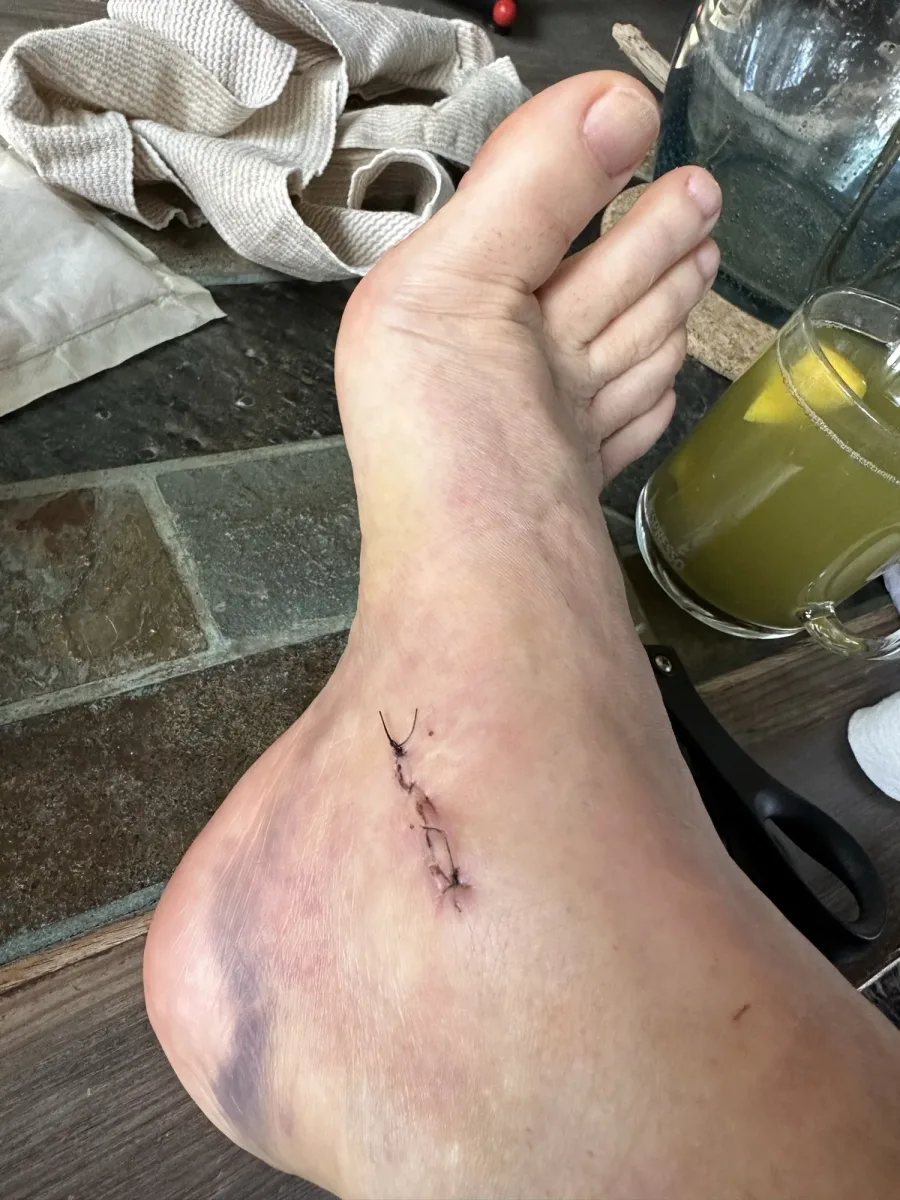
I wanted the titanium hardware removed from my ankle.
I had a plate and twelve screws from the broken leg and bilateral ankle fracture, a tri-malleolar fracture, that had started my CRPS years before.
When the hardware was first put in, I was told it was "state of the art."
Funny enough, those words worried me.
State of the art?
Was I one of the first people to have it?
I would never know.
I could feel my mind starting to run with that thought.
So I stopped it.
The hardware had done its job.
My bones had healed.
But after a few years, something began to feel different.
Have you ever known that something was not right in your body, even when you could not explain why?
I had that feeling.
My ankle and lower leg became more and more stiff.
I was told it was arthritis.
But that answer did not make sense to me.
The discomfort I was talking about was not only inside my ankle joint.
It ran up the side of my lower leg, right where the plate and screws were.
I also had two large screws on the inside of my ankle that went deeply into the bone.
I started reading.
I asked questions.
I wondered if the hardware itself could be part of what I was feeling.
I could not prove that.
But I knew my body well enough to know that I wanted the conversation.
When I went rollerblading, my leg would ache and burn.
The metal felt very rigid inside a body that wanted to move.
The skin around the two large screws in my medial ankle, the malleolar screws, would itch often when I exercised.
After soaking in Epsom salts, the side of my leg could sometimes feel like it was burning.
I used to joke that I felt like my hardware was rusting.
Was it actually rusting?
No.
That was simply the picture my imagination created to explain what I was feeling.
But the symptoms were real to me.
And I wanted answers.
There was another part of this decision that made it much harder.
I had CRPS.
CRPS is a complex pain condition involving changes in the nervous system, pain processing, movement, sensation and other body functions.
Even today, CRPS experts say there is still a lot we do not understand about it.
The current CRPS treatment guidelines describe it as a complex condition and stress the need to look at the individual person rather than use a one-size-fits-all plan.[1]
I did not take another operation on that leg lightly.
I wanted a plan.
My first surgeon did not feel right
My first consultation did not go well.
I brought information with me about a blocking procedure that had been used with CRPS patients.
I wanted to talk about it.
The surgeon slid the information back across the table to me.
I still remember that moment.
It was not simply that he disagreed with me.
I did not need him to agree with everything I had read.
I needed him to be willing to talk about it.
He told me that he did not recommend removing the hardware.
He said he would perform the operation if I insisted, but warned that it might not turn out well and that I could end up disabled.
I walked out scared.
But I also walked out knowing something.
He might have been capable of doing the surgery.
He was not the right surgeon for me.
Have you ever left a medical appointment feeling smaller than when you walked in?
Have you ever reached your car and suddenly thought of all the questions you had been too nervous to ask?
Have you ever wondered if you were allowed to get another opinion?
You are.
So I did.
Then I found someone who listened
My second consultation was completely different.
She listened.
She took my history with CRPS seriously.
She listened to my concerns about the hardware.
She listened when I talked about anesthesia.
And she did something very important.
She arranged a consultation with an anesthesiologist.
Now we had a team.
We could talk about my history.
The CRPS.
The nerve block.
Pain control.
My previous reactions to anesthesia.
And what recovery might look like.
That was the difference.
One doctor closed the conversation.
The other opened it.
One slid my research back across the table.
The other brought another expert into the conversation.
I never forgot that.
Why anesthesia mattered so much to me
I had been through surgery before.
And I did not do well with general anesthesia.
In the past, I would vomit for up to two days after surgery.
It was awful.
This time, I wanted a different experience.
As a functional medicine practitioner, I was already thinking about recovery before I ever entered the operating room.
I thought about my gut.
My nervous system.
Pain medication.
Inflammation.
Sleep.
Food.
Movement.
And mindset.
I wanted to reduce as many extra stresses on my body as I safely could.
Research is now exploring many of these same connections.
Scientists studying the gut microbiome around surgery have found that surgical stress, antibiotics, opioids, changes in circulation and anesthetic medications can all interact with the gut environment.[2]
Researchers are also finding something fascinating.
The relationship may go both ways.
Medicines can affect our gut microbes, and our gut microbes may affect how some medicines are processed by the body.[2]
This is still a growing area of science.
We do not know everything yet.
But for me, the idea was simple.
If I did not need a general anesthetic, I did not want one.
I wanted to give my body the best environment I could for healing.
Could I stay awake?
I asked whether I could have regional anesthesia and a nerve block instead.
Research now gives us good reasons to have that conversation.
A large review involving hundreds of randomized trials found that techniques using regional anesthesia ranked very well for pain control after surgery. They were also linked with lower opioid needs in many situations.[3]
Researchers have also found less nausea and vomiting with some regional approaches compared with general anesthesia.[3][4]
That part jumped out at me.
Remember, I used to vomit for two days after surgery.
This was not a small detail in my life.
It mattered.
With my surgeon and anesthesiologist, we made a plan.
I would stay awake.
My leg would be blocked.
I would not have a general anesthetic.
Surgery day
I had prepared my body.
I had prepared my nervous system.
And I had prepared my mind.
Before surgery, I used hypnosis and calming mental rehearsal.
I kept repeating one simple phrase:
"You've got this."
Then came surgery day.
I stayed awake.
My leg was numb.
I listened to calming audio from my phone.
At one point, soft jazz was playing in the operating room.
I could hear the people around me.
I could feel the energy in the room.
And I felt safe.
That mattered to me.
The energy around us can change how an experience feels.
So can trust.
So can connection.
I wanted to feel that I could talk to my team.
I wanted to know that they heard me.
I wanted to feel that we were doing this together.
I did.
And I rocked that surgery.
Partway through, one of the screws broke as my surgeon worked to remove it from my medial ankle. It was the same screw that had been causing me that itching after exercise.
Because I was awake, she needed my permission to remove the broken piece, and she was able to ask me right there in the moment.
If I had been under general anesthesia, that conversation could not have happened.
She would have had to make that call without me.
This recovery was completely different
I did not spend the next two days vomiting.
I did not feel wiped out.
I did not struggle with much pain.
And I walked out of the hospital.
For me, that was extraordinary.
I had been through surgery before.
I knew what my previous recoveries had felt like.
This was different.
Can I say that avoiding general anesthesia was the only reason?
No.
There were too many pieces.
The nerve block.
My preparation.
Nutrition.
Sleep.
Movement.
Pain management.
Hypnosis.
My mindset.
My family.
And the team around me.
Health rarely comes down to one thing.
That is one of the biggest lessons I have learned.
Then I heard an echo of pain
My work did not stop when I left the hospital.
After surgery, I started to notice little sensations of pain creeping back in.
I called them echoes of pain.
With my history of CRPS, it would have been very easy to become afraid.
What if it is coming back?
What if this is starting all over again?
But I knew fear could become part of the pain experience.
So I went back to my tools.
I listened to hypnosis tracks.
I used self-hypnosis.
I worked on calming my nervous system.
I reminded myself that feeling a sensation did not automatically mean danger.
I did not want my brain learning to fear every feeling coming from that leg.
That was huge for me.
This does not mean pain is "all in your head."
Pain is real.
But the brain and body work together.
Our thoughts, expectations, emotions and sense of safety can influence how pain is experienced.
That is why mindset belongs in the surgery conversation too.
Healing starts before surgery
My own experience later changed part of the way I worked with clients.
I began helping people prepare before and after surgery.
I help them understand how their body functions.
Then we look at the lifestyle pieces that affect healing.
Nutrition.
Movement.
Sleep.
Bowel health.
Stress.
Pain management.
Mindset.
Nervous system regulation.
And the questions they may want to take to their medical team.
Many clients have said something similar afterward:
"I never would have known to think about all of this."
Here is the cool part.
Healing can begin before the surgeon ever makes an incision.
There is actually a name for this.
Prehabilitation.
Instead of waiting until after surgery to think about recovery, prehabilitation prepares the person beforehand.
And this is not just a nice idea.
A 2026 review of 23 randomized trials involving 2,182 surgical patients found that exercise or nutrition-based prehabilitation was associated with about 48% lower odds of complications after surgery compared with usual care.[5]
It also reduced hospital stay.
Another large review looked at 99 randomized trials and more than 8,000 patients. Exercise prehabilitation was also linked with fewer complications and a shorter hospital stay.[6]
Think about that.
We usually think healing begins after surgery.
But the work can begin before you ever enter the operating room.
That is prehabilitation.
And I like to think about the other side too.
Posthabilitation.
What happens after surgery matters.
How you eat.
How you sleep.
How you move.
How you manage pain.
How you support your nervous system.
How you respond to the signals coming from your body.
And how well you connect with the people caring for you.
For me, the whole journey looks like this:
Prehabilitation. Surgery. Posthabilitation.
That is the healing journey.
What my surgery taught me
The biggest lesson was not about titanium.
It was not even about anesthesia.
It was about being part of my own medical team.
There is a huge difference between a doctor who simply tells you what is going to happen to you and one who is willing to think with you.
A good doctor does not have to agree with everything you believe.
But you should be able to ask questions.
You should understand your choices.
Your history should matter.
And you should feel heard.
If you are facing surgery, perhaps you are asking some of the same things I did.
Will I wake up in pain?
Do I need a general anesthetic?
Could regional anesthesia be an option?
Is a nerve block possible?
How will my medical history change the plan?
How can I prepare my body before surgery?
What can I do afterward to support healing?
What happens if I do nothing?
Should I get another opinion?
Ask.
Your doctor brings medical training into the room.
You bring something important too.
You bring the experience of living inside your body every single day.
Good medicine needs both.
And sometimes the first step toward healing is finding someone willing to listen.
Thank you to the surgical team who listened to me, prepared with me and cared for me. I will never forget it.
References
- Harden RN, McCabe CS, Goebel A, et al. Complex Regional Pain Syndrome: Practical Diagnostic and Treatment Guidelines, 5th Edition. Pain Medicine. 2022. The guidelines describe CRPS as complex and multifactorial and discuss interdisciplinary care, rehabilitation and interventional techniques including sympathetic and regional blocks.
- Perioperative gut microbiota homeostasis and its interactions with anesthetic agents: recent advances. 2026. This review describes interactions between the gut microbiome, surgical stress, antibiotics, opioids, circulation changes and anesthetic or analgesic medications during the surgical period.
- Opioid-free vs. opioid-inclusive anaesthesia with or without regional anaesthesia for postoperative pain: a systematic review with network meta-analysis of randomised controlled trials. The review included 885 trials from 59 countries. Regional anesthesia approaches ranked highly for postoperative pain control and reduced opioid requirements, while some approaches were associated with less postoperative nausea and vomiting.
- Regional versus General Anesthesia in Postoperative Pain Management after Distal Radius Fracture Surgery: Meta-Analysis of Randomized Controlled Trials. This orthopedic meta-analysis found lower odds of postoperative nausea and vomiting with regional anesthesia compared with general anesthesia in the included studies.
- Cascavita CT, Hall AE, Shariati K, et al. Exercise- and Nutrition-Based Prehabilitation Programs in Surgery: A Systematic Review and Meta-Analysis. Journal of the American College of Surgeons. 2026. Twenty-three randomized trials involving 2,182 patients found lower odds of postoperative complications and a shorter hospital stay with exercise or nutrition-based prehabilitation compared with usual care.
- Pooled Efficacy and Exploration of Effect Modifiers of Exercise Prehabilitation: A Systematic Review and Meta-regression Analysis of Randomized Controlled Trials. Ninety-nine trials involving 8,222 patients found that exercise prehabilitation was associated with fewer postoperative complications and a shorter hospital stay.
This article shares my personal experience and education. It is not a substitute for individual medical advice. Anesthesia, nerve blocks, surgical preparation and CRPS care should be discussed with your own medical and surgical team.